In this guide
- Two seasonal risks, not one
- The gate hours move with the season
- The year, month by month
- Why does the trail close?
- How bad is the summer heat?
- Will you actually see the view?
- Is winter worth it?
- The two best months
- When is the mountain busiest?
- How far ahead should you book?
- What happens to your money
- A plan B for a closed mountain
Two seasonal risks, not one
Travellers plan Vesuvius around temperature and then meet the two things that actually spoil visits, neither of which is heat.
The first is closure. The park shuts Trail No. 5 for high wind, storms and poor visibility, and the decision is taken on the day, sometimes with coaches already climbing. It is a safety call on a narrow gravel path edging an active crater, and it is not negotiable.
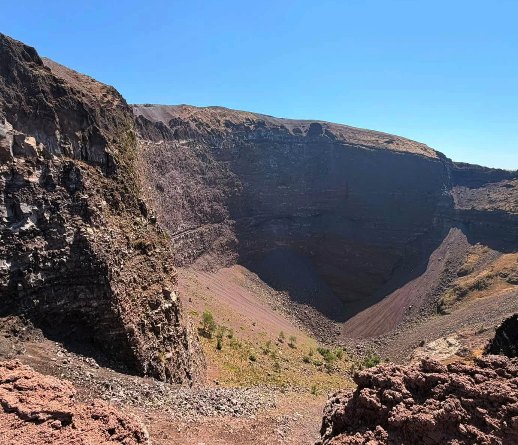
The second is cloud. The summit sits at just over 1,200 metres above a warm bay, which is exactly the geometry that parks cloud on a peak. The trail can be open, the weather at sea level perfect, and the rim inside a white-out. Nobody refunds for that.
Heat is real and manageable. Closure and cloud are the ones worth planning around.
The gate hours move with the season
The park opens at 09:00 year-round. What changes is last entry, and it changes a lot — from mid-afternoon in deep winter to early evening in high summer.
That matters more than it sounds. Last entry in midwinter is around 15:00, which means an afternoon combo running Pompeii first can genuinely run out of mountain. In July and August last entry is around 18:00, which opens up the late slot that is one of the best on the calendar.
Always read the last-entry time on your slot rather than the closing time. The slot is what the gate enforces.
The year, month by month
| Month | Last entry | Closure risk | Heat on the path | View odds | The read |
|---|---|---|---|---|---|
| January–February | ~15:00 | Highest — wind and storms | None | Variable, often crisp | Quietest of the year; go early, accept the risk |
| March | ~16:00 | Moderate | Mild | Improving | Underrated; thin crowds, workable weather |
| April–May | ~17:00 | Low | Comfortable | Good | The best months on the mountain |
| June | ~18:00 | Low | Warm by midday | Good, hazier | Still very good; take a morning slot |
| July–August | ~18:00 | Low | Severe on an unshaded climb | Haze cuts the bay view | Busiest and hardest; first or last slot only |
| September | ~17:00 | Low | Warm, easing | Good | The other best month; summer light, fewer people |
| October | ~16:00 | Rising | Comfortable | Good on a clear day | Excellent value; watch the forecast |
| November–December | ~15:00 | High | None | Variable | Short days, real closure risk, almost no crowds |
Two things fall out of that table. The shoulder months are better than the peak ones on every axis except daylight. And the closure risk is concentrated in the same months that have the fewest people, which is the trade winter offers.
Why does the trail close?
Three reasons, in descending order of frequency.
- Wind. The most common. The rim is exposed at 1,200 metres and the path is loose gravel with an unfenced drop on the crater side. A gusty forecast is enough.
- Storms. Lightning on an exposed summit is the clearest case, and autumn is when the Bay of Naples gets its thunderstorms.
- Visibility. Less common than wind, and it is a safety judgement rather than a view judgement — the guides need to see the group.
What does not close it: ordinary rain, cold, or a busy day. And there is no seasonal shutdown — the mountain is open every month of the year.
How bad is the summer heat?
Bad enough to change how you book, not bad enough to avoid the season.
The Gran Cono path is 850 metres of pale volcanic gravel with no shade whatsoever, and the ash reflects light back at you. On a July afternoon at 33°C at sea level, the climb is hard going and mildly risky for anyone who is not carrying water.
It is also completely manageable at nine in the morning, when the same climb happens in the low twenties with the sun still low. The problem is not July; the problem is a combo that runs Pompeii first and reaches the mountain at two in the afternoon.
The other half of the summer answer is the late slot. With last entry around 18:00, an evening climb in July gives you cooling air, the low sun over the bay, and a fraction of the crowd.
Will you actually see the view?
Most days, yes. Not all days, and the failure is more common than travellers expect.
The clearest air is in the winter and early spring, when a cold, bright day after rain gives you Capri, the Sorrentine peninsula and the whole arc of the bay. The haziest is July and August, when heat and humidity turn the bay into a soft grey smear that photographs badly however clear it feels.
Summit cloud is a separate phenomenon and it is a morning one: cloud that has sat on the peak overnight often burns off between ten and midday. A slot at 09:00 has the best odds on closure and slightly worse odds on view; late morning is the compromise.
The honest position is that this is a lottery you can shorten but not win. Check a mountain-specific forecast the night before rather than a Naples one, because the two are frequently different.
Is winter worth it?
Yes, with eyes open. January and February give you a mountain with almost nobody on it, crisp air on the good days, and the sharpest views of the year.
The costs are real: the highest closure risk of the year, a last entry around 15:00 that squeezes any combo, short daylight, and genuine cold at the rim — it is meaningfully colder up there than in Naples, in every season, and in February that means gloves.
The way to do it is to give the mountain two possible days rather than one. If you are in the region for three or four nights, book the slot for the first clear morning and keep the second as a spare. That converts the main winter risk into an inconvenience.
The two best months
May and September, and it is not close.
Both give you long daylight and a late-ish last entry, comfortable walking temperatures, low closure risk, and clearer air than July or August. Both sit outside the school-holiday peak, so the trail is busy rather than crowded and the slot you want is still available a few days ahead.
April and October are the near misses. April is excellent but slightly cooler and wetter; October is excellent until the autumn storms arrive, which they do without much warning from about the third week.
If your dates are fixed and land in July, that is fine — take the first slot of the day and treat the heat as the planning constraint.
When is the mountain busiest?
The trail has a hard cap of roughly sixty people per ten-minute slot, so it never gets crowded in the way Pompeii does. What varies is whether the slot you want exists.
July and August weekends sell out days ahead, particularly the mid-morning slots that combos want. Easter week and the August ferragosto period are the tightest of all. Outside those, booking the night before is usually enough, and in winter you can often book the same morning.
The car park and the shuttle are where you feel the crowd rather than the trail. A busy afternoon means a long queue for the minibus down, which is the single most common reason a group runs late.
How far ahead should you book?
| When you are going | Book the slot | Book the tour | Why |
|---|---|---|---|
| July–August weekend | 1–2 weeks | 1–2 weeks | Mid-morning slots sell out |
| July–August weekday | 4–5 days | 1 week | Still busy, more give |
| May–June, September | 3–4 days | 4–5 days | Comfortable margin |
| March–April, October | 2–3 days | 3 days | Rarely tight |
| November–February | Night before | 1–2 days | Watch the forecast rather than the availability |
In the closure-prone months the logic inverts: booking early is worse, because you are committing to a date before you can see the weather. Book late and watch the forecast.
What happens to your money
Three different answers depending on the channel, and it is worth knowing before you choose one.
If you bought the park ticket yourself and the trail closes, the park’s platform handles the admission refund. Your train fare and bus fare are gone.
If you booked a tour and the park closes, the operator’s policy governs. The better listings state explicitly that the Vesuvius portion is refunded or rescheduled, and on a combo the Pompeii half usually runs regardless. That wording is a reason to prefer one listing over another.
If the weather looks bad and you want out before the day, free cancellation up to 24 hours before is the instrument, and every tour compared here offers it. That is the real protection on a mountain that decides at breakfast.
A plan B for a closed mountain
Have one. On a closure day you are already in the region with a day to fill, and the good options are close.
- Herculaneum. Ercolano Scavi is the station you would have passed through anyway, and the site is smaller, better preserved and far less crowded than Pompeii.
- The National Archaeological Museum in Naples. Where the best of Pompeii actually went — the mosaics, the bronzes, the frescoes. Indoors, which is the point on a storm day.
- The Vesuvius Observatory. On the flank, the oldest volcano observatory in the world, with a small museum. Open when the summit trail is not.
- Pompeii itself. It does not close for the wind that closes the crater path, and a full unhurried day there is a better use of the time than a rushed half-day would have been.
What not to do is drive up hoping. The gate is at the top of forty minutes of hairpins and the answer does not change when you arrive in person.
Common questions
When is the best time to climb Mount Vesuvius?
Does Mount Vesuvius close in winter?
Why does the trail close?
How hot is the climb in summer?
Will I see the Bay of Naples from the top?
How far in advance should I book?
Where to go next
- The day, hour by hour — where the slot sits in the whole chain
- Independently or guided? — who carries the risk when the gate says no
- Eruptions and monitoring — what the observatory on the flank is watching
- Hours, timing and access — seasonal last-entry times in full
- Vesuvius volcano tour — every trip to the crater, side by side
Tours that fit this trip
Chosen to match what this guide covers, not for what sells.

From Naples to Vesuvius: Bus, Ticket and Smart Audio Guide
The flexible answer in a closure-prone month: a short Naples round trip that costs little to lose and leaves the rest of the day intact.
From $34 per person
Check Availability
Pompeii & Mt. Vesuvius Elite Tour & Lunch From Naples
For a summer booking, a combo with lunch built in — the organised midday stop is worth more in August than in any other month.
From $112 per person
Check Availability
Full Day Tour to Pompeii and Mount Vesuvius from Sorrento
A Sorrento day with the timings handled, useful in the shoulder months when last entry tightens and the schedule stops forgiving delays.
From $123 per person
Check Availability